How can AI-driven collaboration tools support NHS Trusts?

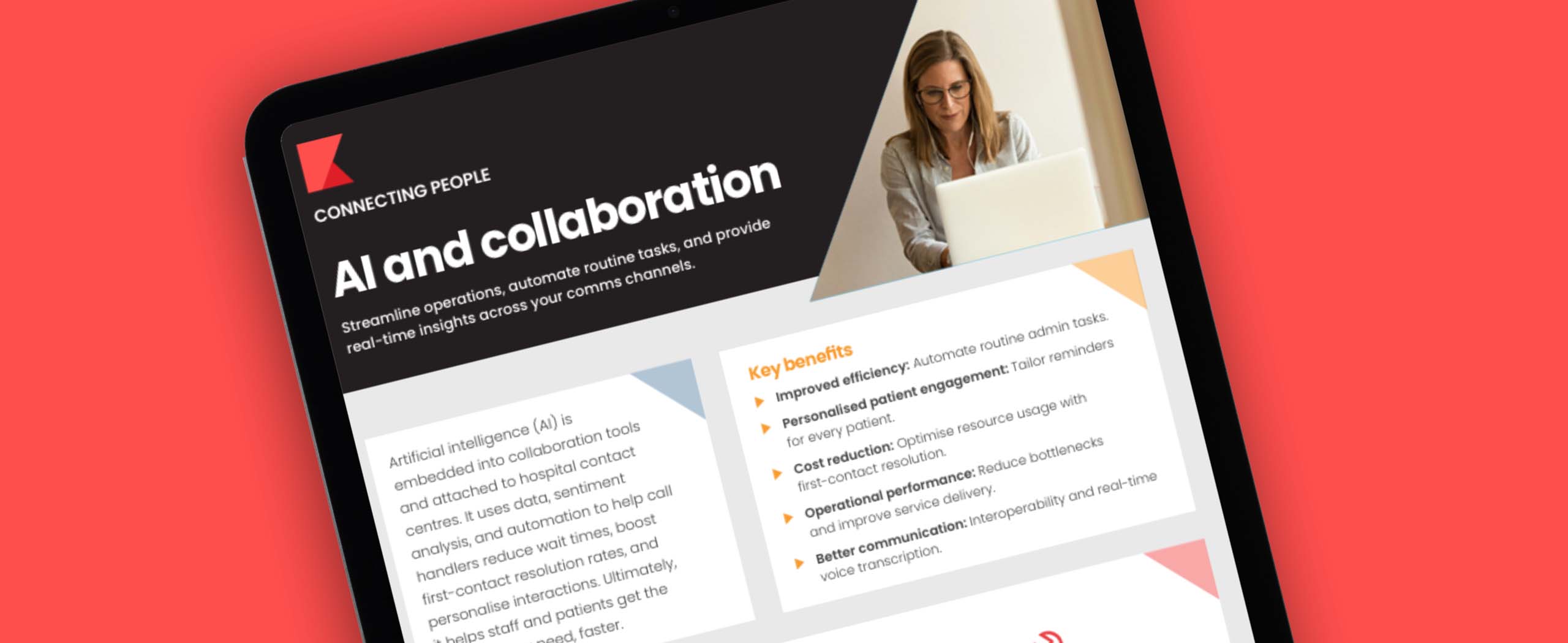
Streamline operations, automate routine tasks, and provide real-time insights across your comms channels.

Artificial intelligence (AI) is embedded into collaboration tools and attached to hospital contact centres. It uses data, sentiment analysis, and automation to help call handlers reduce wait times, boost first-contact resolution rates, and personalise interactions. Ultimately, it helps staff and patients get the answers they need, faster.

Key benefits:
  • Improved efficiency: Automate routine admin tasks.
  • Personalised patient engagement: Tailor reminders for every patient.
  • Cost reduction: Optimise resource usage with first-contact resolution.
  • Operational performance: Reduce bottlenecks and improve service delivery.
  • Better communication: Interoperability and real-time voice transcription.
How to use AI in your collaboration

Elevate comms

Real-time transcriptions, translations, and conversation summaries.

24/7 agents

Answer FAQs, handle appointment bookings, and connect patients.

User moderation

Identify and monitor users, devices, and locations in one place.

Troubleshooting

Monitor system health and resolve issues without disrupting hospital communications.

Triaging patients

Conduct screening surveys, streamline patient flow, and direct patients to specialists faster.

Reliable hardware

Voice-activated controls, noise removal, voice enhancement, and smart search.

Sentiment analysis

Monitor all calls to identify patterns and improve call experiences for future patients.

Patient reminders

Send reminders about medication, appointments, and pre and post-op check-ins.

Key AI technologies for collaboration

  • Agentic AI
  • Natural Language Processing (NLP)
  • Predictive analytics
  • Sentiment analysis
  • User and agent assistance
  • Embedded AI codex and noise reduction

What to look for in AI-driven solutions

  • System integration: Does the solution integrate with your Trust’s EPR? Does it align with the patient journey and current pain points?
  • Scalability: Can the solution adjust to fluctuating demand? Is it able to support remote, district, and community staff in the Trust?
  • Security and compliance: Is the solution compliant with regulations? Will it protect patient data? Do you have a sufficient usage policy for AI?

Creating AI usage policies

AI-driven collaboration tools may already be used in your Trust, even if they haven’t been officially deployed. It’s common for staff to use these tools because they create efficiencies that make sense to them. However, this can expose hospitals to significant risk and potential compliance issues, especially when it comes to patient data.

You’ll need to consider:

  • How to gain visibility over current AI usage.
  • How to harness staff appetite for AI.
  • What policies any collaboration technology must adhere to.

Focus on areas such as protecting patient data, ensuring the right to privacy, being transparent about the hospital’s AI usage, and clearly define accountability.

AI training for staff is also important to make sure they get the most from your collaboration investment, while remaining compliant. Establishing an AI governance board can help oversee deployments, define roles, conduct risk assessments, and provide ongoing monitoring. A robust AI policy will give your Trust the strongest possible foundation for deploying AI-driven collaboration in an ethical and optimised way.

Not sure how to get started with AI-driven collaboration? Our factsheet can help.