Smart hospital technology: how does it work?
Block and UK healthcare organisations are building smart infrastructure that enables intelligent monitoring and better care. Here’s how it works

The UK healthcare sector is going digital
But not just in the ways we expect. Beyond the NHS app and nurses using iPads, hospital infrastructure is getting its own dose of innovative technology.
Smart hospitals combine artificial intelligence, real-time data, and other smart technologies to improve patient outcomes, streamline care delivery, and enhance the overall patient experience.
Most UK Trusts are at the beginning stages or yet to start transitioning their traditional hospital to a smart set up.
However, becoming a smart hospital is an ongoing long term goal for the NHS and a key step to achieving the HIMSS INFRAM framework’s level 7 rating.
What is a smart hospital?
Smart hospitals use IoT sensors to collect real-time data from devices across your campus. All this data feeds into systems which gives you better visibility over what’s happening in your hospital.
For example, you’ll be able to see when medical equipment is moving from one room to another and which areas of your campus are the most populated.
You can use this insight to action different use cases, especially those related to asset management.
- Real-time monitoring to track patient vitals, room occupancy, and equipment usage.
- Artificial intelligence (AI) to make accurate decisions fast and constantly improve outcomes.
- Data-driven insights to optimise workflows, enhance building performance, and reduce wait times.
- Automation to control lighting, HVAC, and emergency alerts depending on building efficiency and context.

What does a smart building network look like?
A smart building’s network is crucial because interoperability and real-time data-sharing are two important success factors. While smart technologies operate as their own individual systems, they rely on sharing a common network.
This enables you to consolidate insights from across the whole building for the full picture, making things easier to manage, more efficient, and painless to add more technologies in the future.
So, the right network will support these technologies with a fast and reliable connection across all your floors and rooms. Wi-Fi will connect your smart IoT sensors as well as any devices needed to use the smart capability (for example, tablets for medical equipment tracking). Some people also opt to also use private 5G networks as a backup connection.
Meanwhile, cloud allows for big sets of data from the smart technology to be processed in real-time, so you can instantly reap the benefits of its insights. Of course, with so much data, security is fundamental here. And network segmentation is a useful defence if smart technology does suffer an attack.
Having a secure and connected network means you can take full advantage of your smart technology without being caught up in tangled processes.


Use smart lighting mapped to a patient’s circadian rhythm.

Detect patient falls and notify staff digitally.

Increase energy efficiency with intuitive HVAC controls.

Enable faster wayfinding to appointment locations.

Monitor air quality and carbon levels.

Install self-check-in screens to cut wait times.

Increase meeting room availability among staff.

Increase security, especially in vulnerable patient wards.

Find vital medical equipment with smart asset tracking.

Make phones calls from connectivity dead zones.
What are the advantages?
Smart building technology ultimately aims to eliminate resource waste and improve experiences for everyone. The efficiencies gained here can help hospitals save costs, reduce their carbon footprint, and care for more patients.
For example, nurses commonly spend time searching for essential medical equipment. Smart asset tracking means they can find what they need and treat a patient immediately.
Elsewhere, smart occupancy monitoring switches off air conditioning and lighting in meeting rooms when not in use. This leads to decreased energy consumption, creating potential cost savings.
How have smart hospitals been implemented?
We have no set blueprint for smart hospitals. You can implement as much or as little smart building technology (and their use cases) as you need. In fact, every project Block works on looks different, depending on the NHS Trust and their priorities.
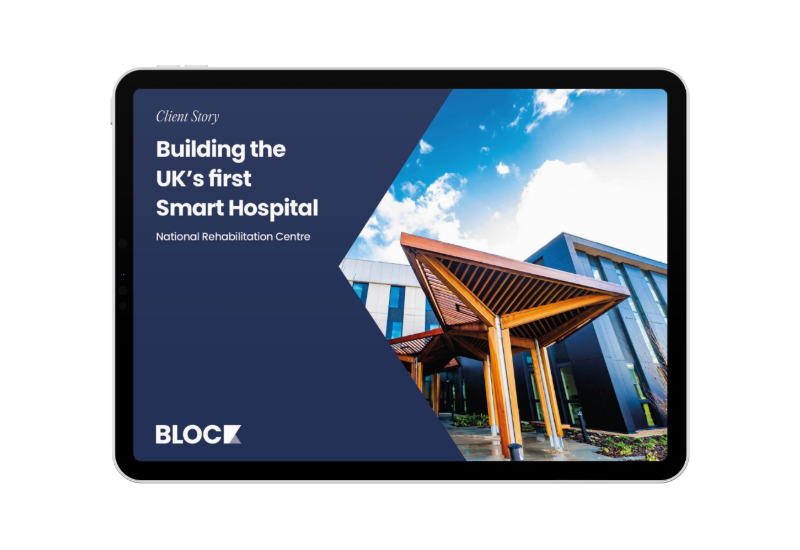
For example, Nottingham University Hospital NHS Trust embedded smart technologies into its new National Rehabilitation Centre. This resulted in:
- Improved response times and fewer falls by using Ascom Smart Nurse to create a 360 visual of patients within single occupancy rooms.
- Improved ease in staff being able to find medical devices after deploying asset tracking with Kio Nurse.
- Better engagement and infotainment solutions for patients staying at the centre with SPARK Fusion.
How Nottingham University Hospital NHS Trust chose its smart technologies

Less stress for staff. More comfort for patients
Smart building technology is just an enabler – the real focus should always be the people that use it. Smart hospitals are creating intelligent spaces that are enjoyable for staff to work in and comfortable for patients. So, what do smart hospitals feel like for people?
For medical staff
- Lessening pressure by decreasing wait times and ultimately reducing burn out.
- Feeling fully supported in accessing everything you need to do your job properly.
- Working with systems that make sense and do what you need them to.
- Treating patients effectively in record times.
- Connecting with colleagues at any time, whenever you need help.
- Remaining safe when dealing with difficult members of the public.
For patients
- Effortlessly calling and texting with loved ones from anywhere in the hospital.
- Accessing the right care when you need it, without long waiting times.
- Recovering in an environment that best meets your needs.
- Staying safe from infections and other illnesses while on the ward.
- Checking in quickly and easily finding your way to appointments on time.
- Feeling reassured you’re getting the best possible care.
For digital teams
- Working with emerging technologies, like IoT, Wi-Fi 7, and real-time location systems (RTLS).
- Upskilling in areas like automation, data analytics, and cybersecurity for IoT.
- Directly improving care delivery, whether it’s reducing staff burnout, making patients feel safer, or streamlining operations.
- Increasing input into clinical, operational, and estates decisions that involve tech.
- Shaping the roadmap for your hospital’s journey from traditional to smart.