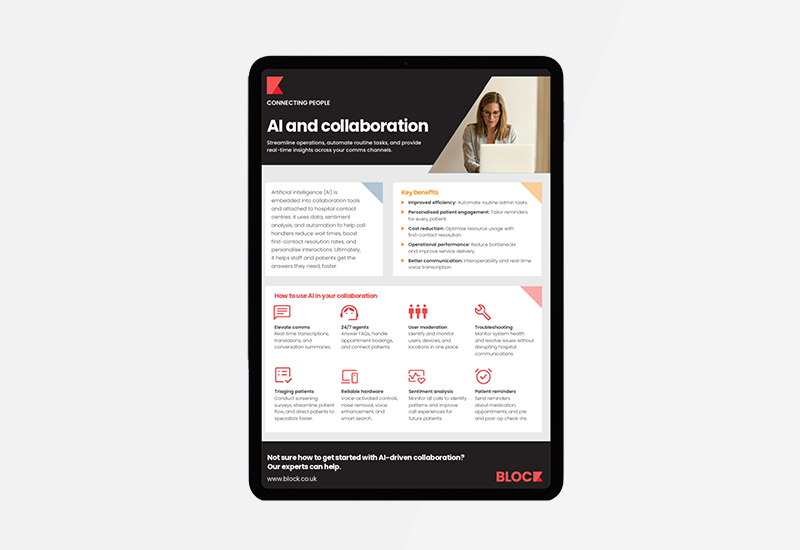
Agentic AI promises to ease communication workflows in healthcare. But what does that really mean for staff on the ground?
In 2025, we began working with Amy Freeman, CDIO at University Hospitals North Midlands NHS Trust on an AI project.
Amy had assembled a dedicated AI team, tasked with finding safe ways of using AI to significantly benefit the Trust. Agentic AI in the Contact Centre has been one of their starting points, and we’ve been lucky enough to work alongside them.
The work at UHNM is part of a growing conversation about how AI can be used to boost public sector efficiency and ultimately patient experience.
Recently, we’ve also been focusing on what Agentic AI looks like in realistic environments, where legacy systems exist, budget control is necessary, and clinical disruption must be minimised at all times.
In fact, I’ve just come back from showcasing Agentic AI at Rewired. It’s clear there’s an interest here, but understandably there are also a lot of questions, and some concerns.
I’m hoping to provide some of those answers here.
Why are Contact Centres the key focus for Agentic AI?
Contact Centres in NHS Trusts pose a low risk, high reward opportunity for hospitals.
Usually calls are from patients with routine requests: ‘Can I reschedule my appointment’, ‘Can you remind me if I need to fast before my test’, ‘Which hospital building is my appointment in?’.
These questions are nothing out of the ordinary. They’re asked multiple times a day. And require a clear, easy answer.
However, they often take call handlers around five minutes to answer because of the admin involved. This adds to call wait times, patient frustration, and abandoned call rates.
Plus, it leaves complex and potentially more urgent callers waiting on the line for help. (These are the patients who truly need call handler’s time – more on this shortly).
Handling routine calls and queries
Agentic AI is capable of answering everyday calls in the Contact Centre. It can do this safely by working from Trust-specific source information such as patient guidelines and medical handbooks.
For example, let’s look at colonoscopy patients. They often need to ring the hospital to clarify pre-op processes because there’s so many requirements. And their colonoscopy will be cancelled if they don’t follow one of these steps, which delays treatment and wastes staff time.
The Contact Centre AI agent can automatically clarify any pre-op steps, using your Trust’s official colonoscopy guidance. For example: ‘What food can I eat 3 days before my procedure?’.
For patients, it means they can call as much as they want during their prep, with no waiting and immediate answers.
Escalating urgent cases
A common concern is the safety of Agentic AI in the Contact Centre. What if someone calls through with an emergency request? What if the AI agent tries to answer a medical question it doesn’t know? Or provides broad medical advice to a question that is patient-specific?
These concerns are completely valid. And they must always be built into the AI agent’s healthcare guardrails.
For example, let’s stick with the colonoscopy example I mentioned above. Imagine a caller asks: ‘I’m on warfarin and insulin, can I still take these while prepping for my colonoscopy?’
The agent will identify the mention of medication. And this person will be passed through to a human to determine what advice is needed.
Supporting staff and reducing call queues
A huge benefit to Agentic AI is conquering lengthy call backlogs, which create a frustrating care experience for patients.
One concern I get when talking about Agentic AI is what will happen to human Contact Centre call handlers. And the answer should be nothing, they’re still a very vital part of solving wait times.
Let’s consider a Trust’s typical Contact Centre queue. Currently, call handlers are diligently chipping away at this queue but not reaching the end.
But there’s potential to divide and conquer this queue. For example, AI agents can take on routine calls that require simple answers.
Meanwhile, call handlers can spend time helping those with more complex questions. This means fewer patients are left waiting.
Multiple languages available
Patients who struggle with English often encounter issues with translation. Whether that means relying on a family member for translations or waiting longer than others for an available translation service (and consequently access to care).
Agentic AI can answer calls in multiple languages, instantly recognising what language the caller is using and replying in the same one. It can also understand accents.
While it may seem like a small feature to some. It opens the door to independence for ESL patients when accessing healthcare.
Keeping an ear on patience experience
Another key concern with Agentic AI is that it will take away from patient experience.
However, AI agents have advanced beyond traditional chatbots. They have the ability to recognise emotion, and respond appropriately.
You can also easily moderate this due to Agentic AI’s ability to process data. You’ll be able to run sentiment analysis across all your calls to see how many were resolved, what patients were calling about, and how satisfied patients were.
This creates a great base to assess how Agentic AI is working in your Contact Centre, and where you can develop things further to improve patient experience.
Interested in seeing what Agentic AI looks like?
Interested in seeing what Agentic AI could like for you?
Access your free demo